
Learn how to enable and configure Emplifi AI capabilities for use with Emplifi Agent.
You can enable the full AI feature set or individual features.
-
Enable AI enables all AI features.
-
Enable AI Summary / Translation / Reply Assistant / Expand with Context / Sentiment Analysis enable individual features.
Individual features only work if Enable AI and the corresponding feature check boxes are selected.
Emplifi AI uses third-party services for some AI features. No customer/client data is stored by a third party (i.e., their large language models will not learn from your data). Always refer to your company’s policies regarding AI prior to enabling these features.
AI features are inherently dynamic and are not driven by a defined set of rules, such as a suggestion or code mapping. Where possible, we provide appropriate prompts to guide the AI tools (and/or allow them to be configurable) and allow you to review AI content before you apply it to a case/response.
AI Summary
AI Summary uses AI to summarize a transcript or detailed notes entered by an agent. Transcripts are typically populated through integrations with bot, social, or telephony platforms.
To generate a summary, click the AI icon in a text entry field. You can review and edit the generated summary before adding it to the case.
The Target Language defaults to the same language as the original text. To change it, click the globe icon and select a different language.
By default, the summary is generated as bullet points. Click Modify to:
-
Summarize as a paragraph
-
Regenerate the summary
When regenerating responses, use the left and right arrows to navigate between previous responses.
|
Field |
Description |
|---|---|
|
Summary Case Text Type |
When you click Add on a summary, a case text entry of this type is created. |
AI Summary supports text entries of up to 50,000 characters.
AI Translation
AI Translation translates case text entries, typically into a common system language. It is available from the Case text context menu for all case text entries when AI Translation is enabled.
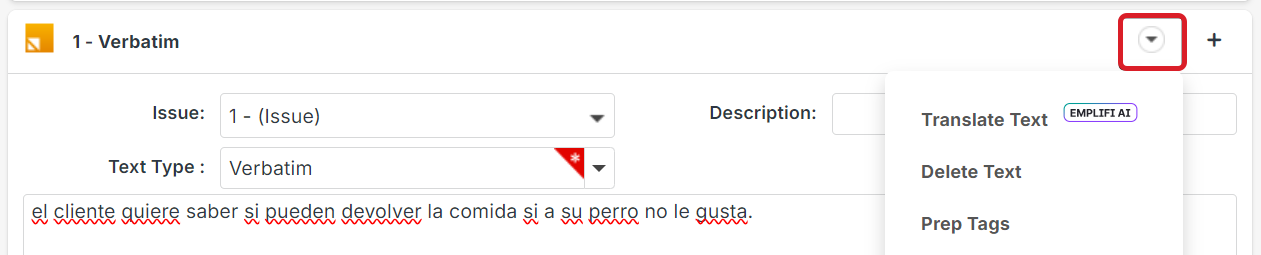
|
Field |
Description |
|---|---|
|
Translation Case Text Type |
When you click Add as Text on a translation, a case text entry of this type is added to the case. |
|
Default Target Language (for translation) |
Language code such as en, es, or cs. If left blank, translation defaults to en. Source and target language pairs are defined by the translation service and cannot be customized. More than 20 languages are supported. Available source and target languages are shown in the Text Translation dialog. |
|
Translation Copy to B Code |
If a B code is entered, a Copy to B Code button appears in the translation interface, allowing the translated response to be copied to a specific case code (for example, |
AI Reply Assistant
AI Reply Assistant helps agents improve email and printed responses by adjusting tone, expanding content, or contextualizing responses.
After AI is enabled for a user’s configuration, the assistant appears in the Case Letter Editing Toolbar via the AI icon.
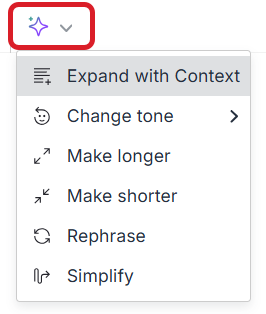
Basic assistant functions allow agents to change the tone or length of highlighted text. These functions require only Enable AI and Enable AI Reply Assistant.
To use Expand with Context, additional configuration is required.
Context sources
The assistant can use the following elements as context:
-
Available transcripts, defined in Script Case Text Types
-
Case elements, defined in the Context Metadata Standard Paragraph
-
The full case letter, including text before and after the selected text
The use of context is experimental. Generative AI may not always use the provided context as expected. Test multiple scenarios and ensure agents review and adjust generated responses before sending them.
Context Metadata Standard Paragraph
Defines additional case elements that can be used by AI Reply Assistant when generating responses.
Making context configurable helps:
-
Provide only relevant case information
-
Reduce the likelihood that sensitive information is sent to external services
Each context element includes:
-
Label: A descriptive name used in your environment. For example, if the typical term for your locations is restaurants, using restaurant as the label will increase the likelihood of that context value being used by the AI assistant.
-
Value: A combination of fixed text and/or standard paragraph inserts.
Paragraph rules:
-
The paragraph must contain a valid JSON object.
-
The content must be plain text with no HTML.
-
If pasting content from another source, insert it as plain text.
Use View Metadata Paragraph to preview the paragraph.
-
If the JSON is invalid, the message Current JSON is not valid appears.
-
When valid, a green checkmark appears.
-
Enter a case ID and click Preview to see the metadata that would be sent.
You still need to edit and save the paragraph on the standard paragraph admin page.
Example JSON configuration:
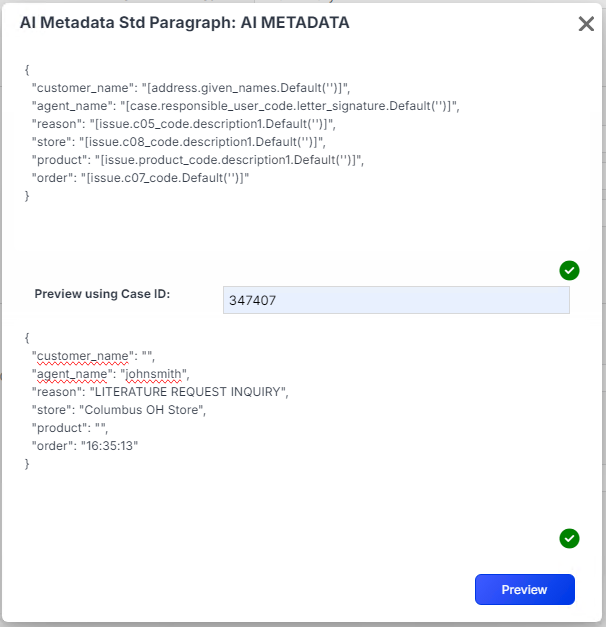
{
"customer_name":"[address.given_names.Default('')]",
"agent_name":"[case.responsible_user_code.letter_signature.Default('')]",
"reason":"[issue.c05_code.description1.Default('')]",
"store":"[issue.c08_code.description1.Default('')]",
"product":"[issue.product_code.description1.Default('')]",
"order":"[issue.c07_code.Default('')]"
}
Use the paragraph preview feature on the Standard Paragraph Administration page to test the paragraph.
Additional configuration options
|
Field |
Description |
|---|---|
|
Include letter for context |
If selected, the content of the letter before and after the highlighted text is included when expanding content with context. This helps prevent duplicated greetings or repeated information. Note: Do not enable this option if the letter may contain personally identifiable information that should not be sent to AI services. |
|
Script Case Text Types |
Case text types used as transcript context for AI Reply Assistant. Common examples include Chat Transcript, Call Transcript, and Agent Notes. |
Plain text is sent to the AI service, so formatting may not be preserved. Reapply styling if needed after inserting the generated response.
AI Sentiment Analysis
AI Sentiment Analysis evaluates the emotional tone of incoming emails and case text and assigns a sentiment value of positive, neutral, or negative. The result is displayed on the case as an emoji indicator so agents can quickly understand the customer’s emotional state.
|
Field |
Description |
|---|---|
|
Enable AI Sentiment Analysis |
Enables the sentiment analysis feature for users assigned to this configuration. Sentiment analysis is performed when an inbound email is processed. The assigned sentiment (positive, neutral, or negative) appears on the case as an emoji indicator. |
Prerequisites
To use AI Sentiment Analysis, the following must also be configured:
-
Mailbox Settings: Enable AI Sentiment Analysis and optionally define a queue for routing negative-sentiment cases. For more information, refer to Email Service - Mailbox Settings.
-
Company Setup: Configure the required company-level settings in Company Definitions.
For more information, refer to AI Sentiment Analysis.